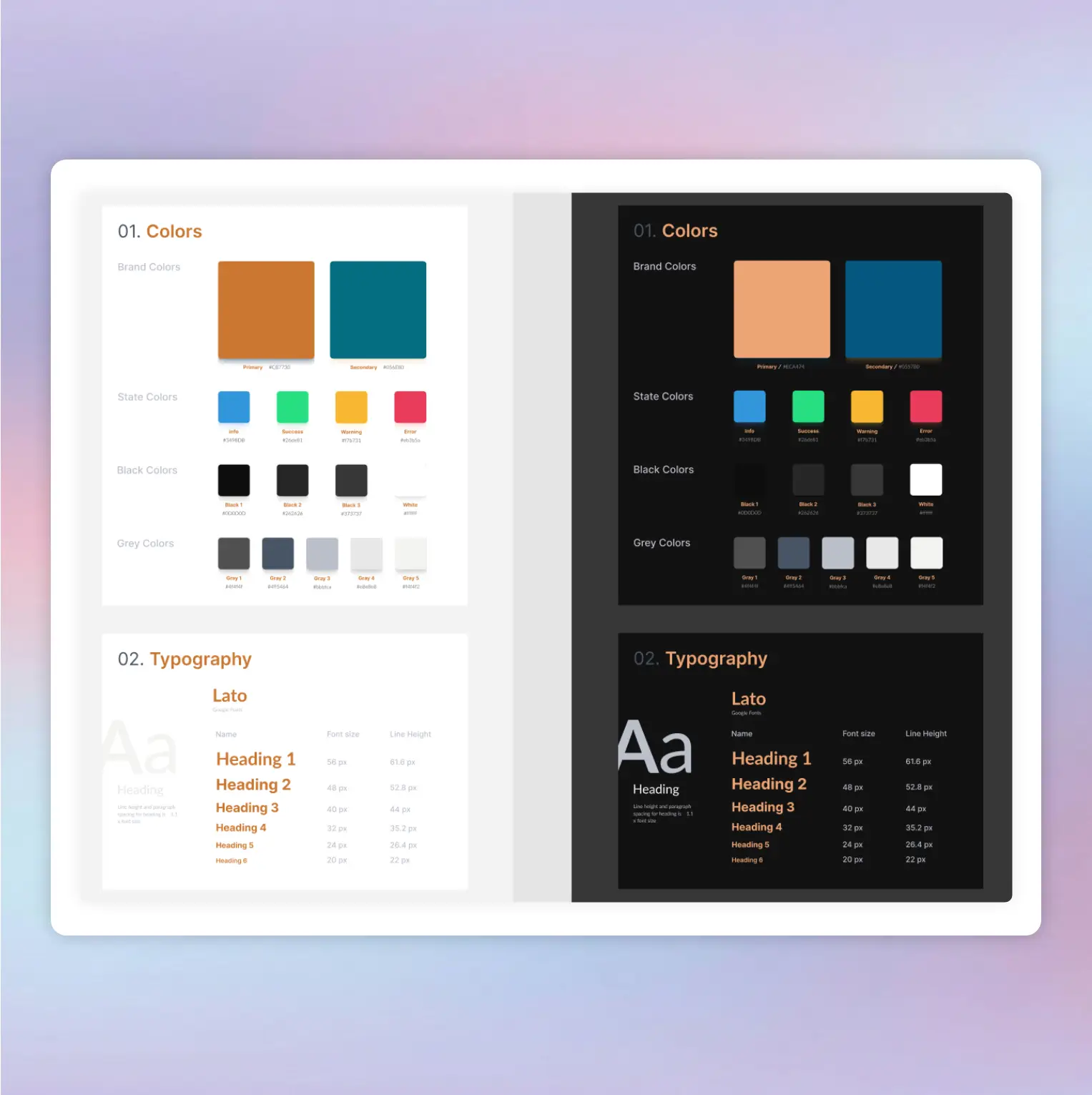
Establishing a shared UI foundation across multiple products
The company operated two main brands and multiple digital products, each evolving independently. Before redesigning individual experiences, it became clear that the lack of a shared visual and interaction foundation would limit consistency, speed, and scalability.
I proposed starting with a unified UI foundation in Figma that could be shared across teams and products. This foundation would later evolve into a design system and support ongoing product work.
An existing style guide was available and used as a reference, but it was outdated and not structured for reuse across modern product workflows.
Understanding the problem
The work started with an audit of the existing style guide and active interfaces to understand inconsistencies and gaps. From there, I defined a core set of design principles and UI elements that could be reused across products without limiting flexibility.
The focus was on building a practical, production-ready foundation rather than a static documentation artifact.
Main activities:
• Review of existing UI patterns and components
• Definition of core design tokens and principles
• Creation of reusable components in Figma
• Organization of the library for cross-project adoption
UI Design
Instead of redesigning entire interfaces upfront, the priority was to establish reliable building blocks that would support future work.
The library included:
• Color system and typography
• Iconography and spacing rules
• Form elements and inputs
• Base components designed for reuse
This approach allowed teams to focus on solving product problems rather than recreating UI patterns for each new project.
Outcomes & impact
Reduced design inconsistencies across products
Faster UI production and iteration
Improved collaboration between design and development
Created a clear path toward a scalable design system
Key learnings
This project reinforced the value of investing early in foundations. While building a shared UI library required upfront effort, it significantly reduced long-term friction and enabled teams to focus on higher-level product challenges.
It also highlighted the importance of designing systems that are meant to evolve, rather than treating style guides as static artifacts.